
When a sexual assault leaves you feeling ashamed, speaking up can feel like begging for attention. Those false narratives keep you quiet. They silence survivors. They protect perpetrators.
The Reality An entitled and deeply broken person committed a crime against you. Never your fault. Yet the legal system dumps the burden on you—the one carrying the trauma—to fund, fight, and prove your case for a minuscule chance at justice. Our patriarchal system shields perpetrators and burdens survivors. It protects attackers, not victims.
Until assailants confess, publicly apologize, and actually take responsibility, you carry the weight of their crimes. A quiet apology that doesn’t lift the burden off your shoulders fixes nothing. It just placates you, quiets you, and leaves you strangely empty.
This campaign flips the script. Instead of hiding the scale of harm, we force it into the open.
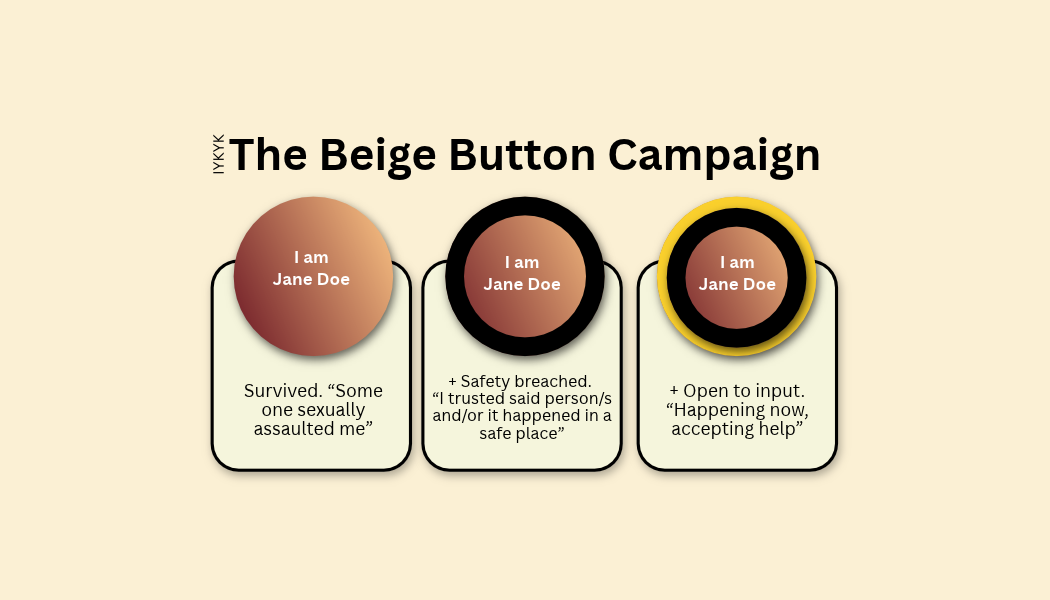
The Beige Button Campaign Wearing a beige button quietly signals to other survivors that someone sexually assaulted you. Should all survivors wear these pins, the collective message will become impossible to ignore: perpetrators a’plenty walk among us. That visible wave pushes sisters and allies to speak out, organize, and demand systemic change. All of this, without you saying a word.
Why beige? Beige stands in for privilege—male privilege, unchecked entitlement. Mundane enough to blend in. Malicious enough to hide in plain sight. Beige is bland, boring, and probably dim-witted. The spectrum reflects every skin tone it impacts.
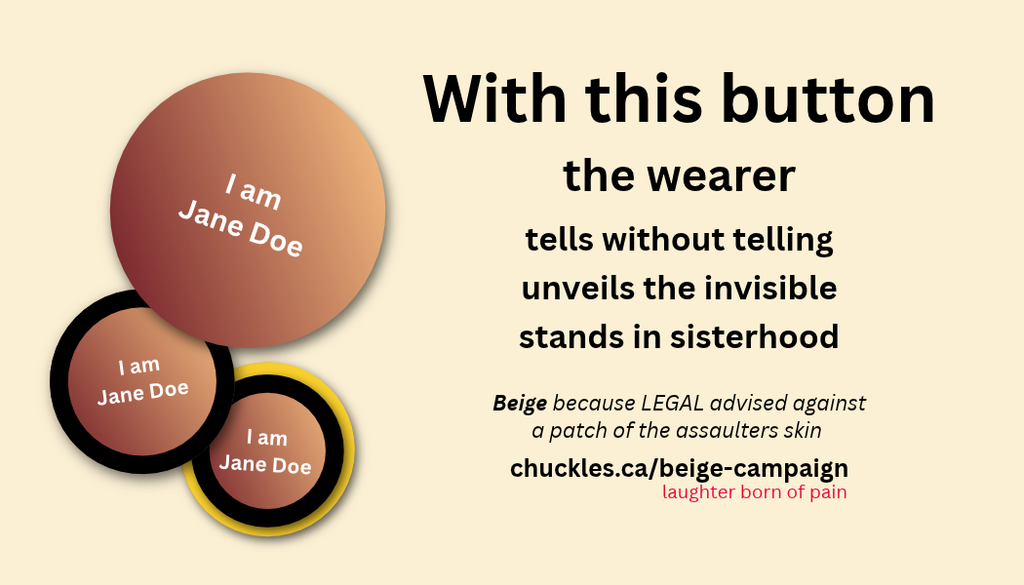
The Purpose In wearing this button, the wearer:
- tells without telling
- unveils the invisible
- stands in sisterhood.
Your Questions, Answered
Q: What’s the chuckle? What the fuck is funny about sexual assault?
A: Nothing. It’s currently being hosted here because it’s a new site, unvisited, for testing purposes. If you’re seeing this, lucky you. It’s by invitation only.
Q: If I wear the button, do I have to give details to anyone who asks?
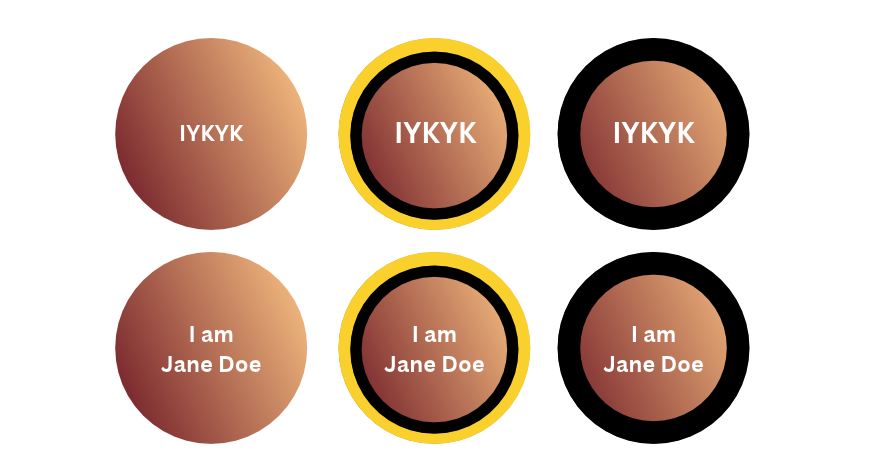
A: No. Your story is yours. You owe nothing. This campaign is about showing what another person did, not telling what happened to you. Other wearers know not to ask. That’s the IYKYK principle. And the pin is available in “I am Jane Doe” and “IYKYK” formats.
Q: Who is Jane Doe?
A: “Jane Doe” is the pseudonym of the woman suing Cornell University. Story here. There’s a call out to name her. Nope. Name the men who assaulted her. Name the 50 men who knew this was happening and did nothing. This particular “Jane Doe” has an extraordinary amount of courage, full well knowing that the patriarchal system is set to protect the “promising futures” 🤮 of these young men. Any woman who has experienced sexual assault is a “Jane Doe,” and by wearing her name we protect her anonymity, declare solidarity with her, and show she is not alone.
Q: What’s the difference between sexual assault and rape?
A: Sexual assault covers every non-consensual act, from unwanted touching to penetration. Rape is just one subset of sexual assault.
Q: Isn’t that a big ask, that assailants “confess, publicly apologize, and actually take responsibility”?
A: Indeed. The solution? Don’t fucking sexually assault. Anyone. Ever. And if you do (or ever did), find your backbone and own what you did to another human being. Get help. Get better. And don’t ever do it again.
Q: What does the black edge signify?
A: The black edge marks a breach of expected safety. It means someone you trusted—a parent, sibling, partner, friend, or family member—violated you. It also signals assaults that happened in spaces that should have kept you safe: your home, your school, a doctor’s office. You were supposed to be secure there. Not ready to name who or where? The plain beige button covers every scenario. You control what you show.
Q: What does “Happening now, accepting help” (black edge, then amber rim) mean?
A: The outer amber rim signals that you’re currently living with or near your abuser. It lets fellow survivors know you’re open to support right now, without requiring you to ask. You always control whether you accept help.
Q: Why is there no amber rim around the plain beige button?
A: The plain beige button signals that you’ve survived sexual assault and you’re safe right now. It quietly tells other survivors they belong to a sisterhood. Over time, wearing these pins will expose the widespread harm that too many unnamed, unaccountable perpetrators (mostly men) inflict on others (mostly women, girls, and boys). Plain beige and its different iterations will build the visibility required to drive systemic change.
Q: I’ve heard some people say that these kinds of experiences make survivors more resilient, what are your thoughts on that?
A: Fuck resilience. The term serves to placate. You are strong, and always were. Instead of treating survival as some gift delivered by a clenched fist, let’s start talking about how sick someone must be to resort to sexual assault.
Remember this: Rape doesn’t “just happen,” it is fucking done.
Q: Where do I get one?
A: If you’re in Canada, use the form below, send me your address, and I’ll mail you one. Free. Just be sure to let me know which one, plain or with edging. If you’re from elsewhere, reach out and we’ll figure out the postage.
Q: Can I make my own?
YES! Here’s the artwork for the 1.25″ pins. Free. Please share!
Need support now?
- Talk Suicide Canada: 1-833-456-4566 (call) | text 45645 (4pm–midnight ET)
- Kids Help Phone (under 21): 1-800-668-6868 | text CONNECT to 686868
- Find a local sexual assault centre in Canada here.
Leave a Reply